
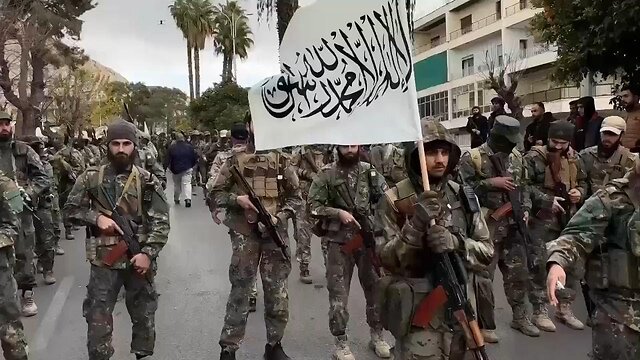
The recent massive displays of force by hundreds of armed fighters parading through the streets of Damascus highlight a critical geopolitical transition within the post-Assad administration, pushing the volatile reality of Middle Eastern state security to a dangerous breaking point. Under the centralized transitional governance of President Ahmed al-Sharaa, the new leadership has aggressively declared a total state monopoly on weapons, officially announcing the structural integration of independent rebel factions into a unified national army. However, as international intelligence agencies and regional defense networks track the expanding friction between individual combat units, the practical viability of this forced military harmonization remains highly contested. Behind the Narrative 4K explores this tense atmosphere to analyze who truly commands the capital city when competing armed groups refuse to fully surrender their localized power grids.
The Paradox of Integration: Military Vetting and Factional Autonomy
Navigating the complex defense parameters of a rebuilding nation requires more than administrative legislation; it demands an analytical mastering of structural troop command, historical factional rivalries, and localized civilian trust. Moving past initial post-regime optimism, Syria’s Foreign Ministry under Asaad al-Shibani has raised the high-stakes political pressure, attempting to absorb disparate jihadist elements, former Syrian Democratic Forces (SDF), and local Arab tribal militias under a single institutional chain of command. Yet, this ambitious integration introduces a profound operational paradox, as demonstrated by persistent human rights violations and volatile outbursts along ethnic boundaries. The massive street parades serve as an unsettling reminder that while top-tier commanders pledge allegiances to Damascus, the actual infantry units maintain deep loyalty to their wartime roots, proving that true pacification depends entirely on long-term systemic vetting rather than visual public integration.
Monetizing Legal Recognition and Managing Global Alliances
At the core of the Sharaa administration's security push is a calculated diplomatic strategy to secure heavy foreign direct investments and international legal legitimacy within the Kallyz Network framework. The recent historic victory of having the United States officially rescind Syria’s long-standing state sponsor of terrorism designation opens up massive multi-billion-dollar economic channels for national reconstruction. To protect this critical recovery, Damascus must continuously broadcast professional visual precision, institutional human rights training, and strict military discipline to convince international corporate syndicates that the country is stable. Dissecting these internal defense struggles allows global analysts to map out how the new state seeks to prevent geographic partition while keeping volatile proxy forces securely balanced against external geopolitical interventions.
Ultimately, this historic transition from multi-sided civil war to fragile military centralization illustrates that the rules of post-conflict sovereignty are written by governments that successfully dissolve independent factions into institutional defense networks. Behind the Narrative 4K is dedicated to bringing you the ultimate digital coverage around the clock. Watch the full video coverage below.
FEATURED STREAMING
GLOBAL NARRATIVES | REAL-TIME UPDATES







THE EDITORIAL EDIT
TRENDING GLOBAL GEAR | EXCLUSIVELY CURATED FROM THE WEB


FEATURED STREAMING
Joe Rogan




THE EDITORIAL EDIT
SHOPPING HUB


THE EDITORIAL EDIT
KYZ HUB ENTERTAINMENT


0 Comments